Bitrix24 and MoySklad for CIS operations: what a foreign company should know
Two systems that dominate CIS back offices, how they map to Western CRM and ERP concepts, and how to connect them to your head-office stack.
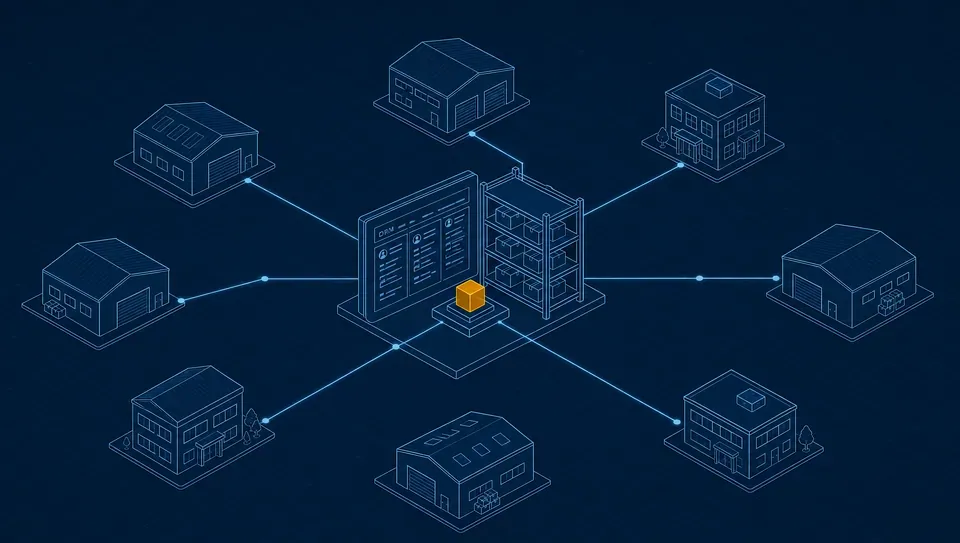
A foreign company opening a subsidiary or a distributor in Central Asia usually discovers that its sales and warehouse teams already work in two systems it has never heard of. Here is what they are and how they fit a Western stack.
Bitrix24
Bitrix24 is a CRM with tasks, documents, telephony and messengers in one product. It is the default CRM in the CIS the way HubSpot or Salesforce are elsewhere. The closest mapping: leads and deals as in HubSpot, tasks and projects as in Asana, an internal chat as in Slack, all in one interface. Telephony and Telegram or WhatsApp channels connect natively, which matters in a region where a large share of sales happens in messengers.
MoySklad
MoySklad is a cloud inventory and order system: products, warehouses, purchases, sales, retail POS, light manufacturing, and reports. Think of it as inventory and order management without the accounting module. Bookkeeping in the region is done in 1C by the accountant, and MoySklad exchanges documents with it.
Why not bring your own system
You can, and for a head office it is often right. The problems appear at the operational level: local fiscal requirements for retail receipts, local marketplaces and payment systems, telephony providers, and staff who know the local tools. A local system for local operations, connected to the head-office stack, is usually cheaper than adapting a global system to a small market.
How the connection works
We connect Bitrix24 and MoySklad to your systems through their APIs: deals and orders flow up, products and prices flow down, with an exchange log that a manager can read and alerts within an hour of a failure. Typical integration work starts at $300 per pair of systems and takes one to three weeks.
What to decide first
Which system is the master for each entity: customers, products, prices, orders. Most integration failures come from two systems both believing they own the same data. We settle this in a one-page design document before any exchange is built.